Device communication and controls
Developed web controls for rectifier DC output voltage, current limits and read requests. The interface supports a shared CAN target, broadcast selection and direct targeting when a rectifier is selected.
Embedded Linux controller development spanning CAN / Modbus, power-system integration and architecture planning.
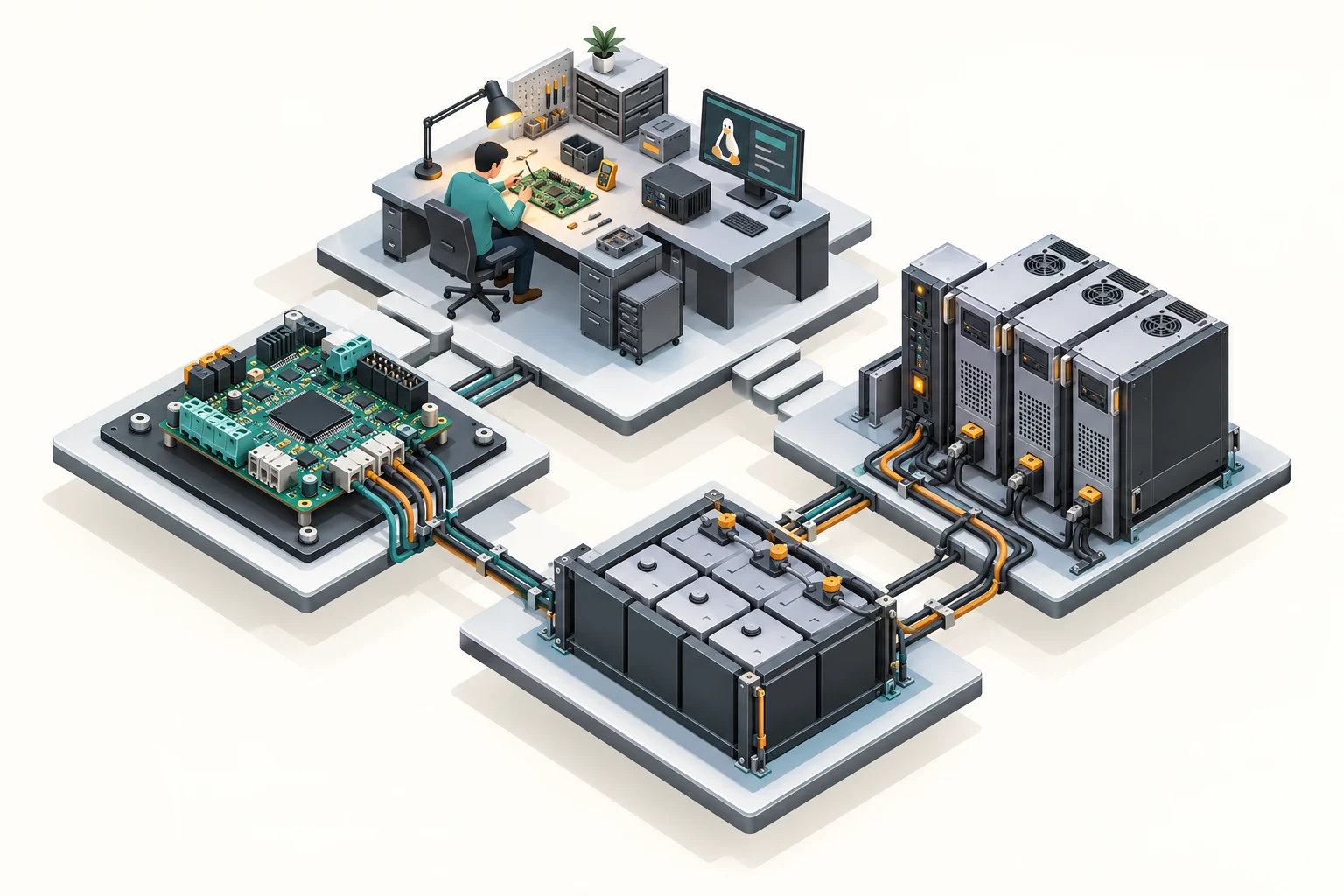
01 / OVERVIEW
Simplified conceptual overview of the work, not an implementation schematic.
02 / THE CHALLENGE
Power-system development crosses several boundaries: the CAN bus, application services, an operator interface and the Linux image deployed to the target. A change only becomes useful when those parts work together on the device.
03 / MY CONTRIBUTION
Developed web controls for rectifier DC output voltage, current limits and read requests. The interface supports a shared CAN target, broadcast selection and direct targeting when a rectifier is selected.
Added visibility of the rectifier-reported current limit, bringing device feedback into the same workflow as command entry.
Work with the PHYTEC phyCORE-AM62x / phyBOARD-Lyra platform, Yocto images, CAN / Modbus communication and Redis-backed application state. Development includes target bring-up, deployment checks and hardware/software debugging.
Work includes IP configuration, memory planning, controller architecture, DC–DC converter integration and solar-system integration.
Perform hardware validation, bench testing, target bring-up and hardware/software debugging.
Investigated peripheral integration on the AM62 platform, including I²C device discovery, addressing and voltage-domain compatibility with an external ADC.
The ongoing engineering scope includes battery capacity and state-of-charge settings, current and power limits, Ethernet configuration, firmware-update recovery and audit records. These topics form part of continuing controller development.
04 / VALIDATION
Development uses on-target checks alongside source and image verification. My Yocto workflow distinguishes rapid devtool deployments from changes integrated into an image, helping identify when the software running on a board does not match the intended source revision.
05 / OUTCOME & REFLECTION
The work includes implemented rectifier controls and device feedback, alongside continuing controller development. Firmware-update recovery, configuration persistence and audit logging remain part of the continuing lifecycle design work.
The most useful diagnostic is often the connection between layers: what the interface requested, what the communication service sent and what the hardware reported back.
LET’S CONNECT
Have a product, an integration challenge or an engineering role in mind?
I’d be happy to hear about it.
Privacy: anonymous session statistics and approximate connection-based location help improve this portfolio. No raw IP addresses are stored. Do Not Track is respected. Records expire after 90 days.